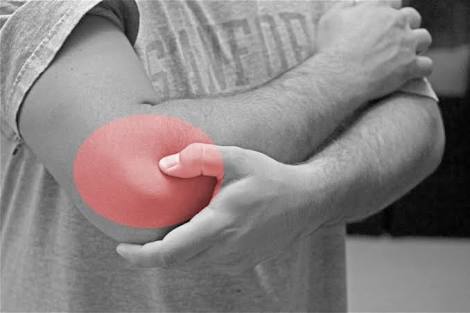
Focus on : Tennis Elbow

What is Tennis Elbow?

Tennis elbow, also known as Lateral Epicondylitis, is a common condition characterised by pain at the outside of the elbow with movements of the wrist and hand.

The pain is usually localised to the tendon of a small muscle of the forearm just below the elbow called Extensor Carpi Radialis Brevis (ECRB).

This muscle is responsible for extending the wrist back into a “stop” position and is active when gripping and moving objects.

While the term ‘tennis elbow’ is used because this is a common injury for tennis players, anyone who performs repetitive tasks with their hands and wrists can be susceptible, including office workers and manual labourers.

What are the signs and symptoms?

The cardinal sign of tennis elbow is pain felt on the outside of the elbow, particularly when making wrist movements or when gripping an object.

Symptoms may occur suddenly or appear gradually over time. In the early stages, pain may be present with activity and quickly go away with rest, however, as it progresses the pain may be more constant, lasting for longer and occurring with smaller movements.

If pain has persisted for three months then it is considered to be a chronic condition. As with most injuries, the longer an issue has been present, the longer it usually takes to resolve.

Other symptoms can include night pain, stiffness in the elbow and forearm, weakness, numbness and pins and needles. As symptoms progress, simple tasks such as lifting a cup can be painful, which can have a significant impact on your lifestyle.

What causes it?

While tennis elbow was originally thought to be due an inflammation process, it appears that this is not the case, rather there is an increased sensitivity to the area along with changes to the blood supply and disorganization of the collagen fibres that make up the tendon.

These changes are an adaptation to excess loading of the tendons attaching to the elbow, particularly the ECRB.

Most of the time, this happens because of small repetitive movements that are done with poor ergonomics or technique. If the health of the tendon tissue is compromised, this can also contribute to the development of tennis elbow.

Poor nutrition, disuse, inflammatory diseases and aging can all mean that the tendon is less able to adapt to forces and are a risk factor for the development of tennis elbow.

How can Addlife Physio help?

Your physiotherapist will first confirm that you are indeed suffering from tennis elbow, which is an important step as some neck conditions can present with similar symptoms.

Once the diagnosis has been confirmed, we will determine the severity and causes of your particular condition, testing your grip and individual muscle strength.

We can also identify any muscle tightness, postural or ergonomic flaws and joints stiffness that may be contributing to your condition.

Treatment may include, fitting of a brace, dry needling, strengthening with eccentric exercises and stretching.

Depending on the cause of your tennis elbow, your physio may suggest a change in the setup of your desk, workplace, or grip technique of your racket or hand-held tool.

Eccentric exercises load the muscles in a very specific way and research has shown that these exercises can help strengthen tendon tissues, reducing symptoms of tennis elbow.

It is normal for tennis elbow to take a few weeks or even months to heal. If conservative management is not having a good effect, your physio can help you speak to your doctor about other management techniques.

As tennis elbow is a progressive condition that generally does not resolve on its own, it is recommended to seek treatment sooner rather than later, as recovery is much faster when started early.

If you or anyone you love are experiencing Tennis elbow, we understand the frustration of the nagging pain and depending on the situation, we can help alleviate it for you and get you back to your best.

All you have to do is call us on 0405 333 921 and have a quick, friendly chat with our team to organise a convenient time so we can help you get back to 100% before you know it.

None of the information in this article is a replacement for proper medical advice. Always see a medical professional for an assessment of your individual condition.

Focus On Anterior Ankle Impingement

What is it?

Anterior ankle impingement, also known as anterior impingement syndrome, is a musculoskeletal condition where repetitive forces compress and damage the tissues at the front of the ankle, causing pain and stiffness. It is a common injury that can affect people of all ages, however is usually seen in athletes of sports involving repetitive or forceful upward movements of the ankle, such as sprinting, landing from long jump, uphill and downhill running.

What are the symptoms?

Pain at the front of the ankle is the primary symptom of anterior ankle impingement. This can be felt as an intense, sharp pain occurring with ankle movements or a dull ache in front of the ankle following periods of exercise. Pain can also be felt when putting weight through the ankle while standing, walking or running. Night-time aching, stiffness, swelling and reduced ankle flexibility are also common symptoms of anterior ankle impingement.

How does it happen?

Anterior ankle impingement is caused by traumatic or repetitive compression to the structures at the front of the ankle as the tibia and talus move towards each other during ankle movements. The tissues that are affected become damaged and inflamed, causing the pain typical of ankle impingement. Chronic inflammation can lead to further stiffness, exacerbating the impingement process.

The most common risk factor for ankle impingement is a previous ankle sprain that was not adequately rehabilitated, as this can result in a stiff or unstable ankle. Another cause of impingement is the growth of small osteophytes or bony spurs around the ankle joint that press against the nearby soft tissues. These can be due to osteoarthritis or grow as a reaction to impingement itself. Training errors, muscle tightness, unsupportive footwear and a hypermobile ankle have also been shown to be risk factors for anterior ankle impingement.

How can physiotherapy help?

Depending on the cause, mild cases of anterior ankle impingement usually recover in one to two weeks with rest and physiotherapy intervention. For more severe impingement, the ankle may require up to six weeks of rest and rehabilitation to recover. In rare cases, surgical intervention will be required to remove any physical causes of impingement, such as osteophytes to restore impingement free movement of the ankle. Your physiotherapist will first identify the cause of your ankle impingement and help you to choose the best course of action to reduce your symptoms. They are able to advise you on the appropriate amount of rest and provide stretches and exercises to restore strength and flexibility to the ankle.

Mobilization techniques and range of motion exercises can also reduce stiffness of the ankle, restoring normal joint movement. Moreover, balance and proprioception exercises are included to prevent further ankle injury. Balance exercises challenge the way your body reacts to outside forces. With this, your balance will be improved, and you’ll have a more stable ankle.

Ideally, physiotherapy treatment is the first step before considering surgery. If surgery is required, your physiotherapist can help you to make a full recovery with a post surgical rehabilitation program.

If you’d like some help with your painful ankles, then call us at Addlife Physio now on 0405 333 921

None of the information in this newsletter is a replacement for proper medical advice. Always see a medical professional for advice on your individual condition.


What you need to know about Osteoarthritis and your hips

What is Osteoarthritis (OA)?

Osteoarthritis (OA) is a degenerative disease that affects the cartilage of joints. Cartilage is a firm, flexible connective tissue that lines the surface of many joints and provides shock absorption and cushioning for the bony surfaces of those joints as they move. During the process of OA, cartilage gradually begins to break down and is worn away. This means that the bony surfaces below the cartilage start to rub together, creating increased stress and friction. The body reacts to this increased stress by creating small bony deposits around the joint, as more of these are created the joint becomes increasingly painful and difficult to move.

The hip is one the joints most commonly affected by osteoarthritis. While OA is generally considered to be a disease associated with aging, younger people can be affected, particularly following trauma to the hip. As a general rule, however, the cartilage in our bodies loses elasticity as we age, making it more susceptible to damage. Other risk factors for the development of OA are a family history of OA, previous traumatic injury of the hip, obesity, improper formation of the hip at birth (developmental dysplasia), genetic defects of the cartilage, impingement of the hip (femoroacetabular impingement) and a history of intense weight bearing activities.

What are the signs and symptoms?

The most common symptoms of hip OA are pain and stiffness with reduced movement of the hip, particularly in the direction of internal rotation. These symptoms in a person over the age of 50, in the absence of a trauma that may have caused a fracture, indicate possible OA. Pain originating from the hip joint can be felt as a deep ache that can be noticed in the groin, buttocks, thigh or even knee. It is also typical for sufferers of OA to experience stiffness in the morning upon waking that lasts less than 30-60 minutes. Grating or cracking sensations with hip movements are also common complaints, along with mild to moderate joint swelling.

In the early stages, mild pain may be felt with activities such as walking or running. As the disease progresses these activities will become more painful with the muscles that provide additional support to the joint becoming weaker, exacerbating the disease process. For many people, a total hip replacement may be necessary to reduce pain and restore function.

How can physiotherapy help?

For mild to moderate cases of OA, physiotherapy can help to reduce pain and maintain function for as long as possible. Keep the musculature around the hip as Strong and healthy as possible can have a significant impact on your quality of life and your physiotherapist work with you to help you to set and reach your goals for treatment

Treatment will also include stretching, trigger point therapy, joint mobilization to increase the joint’s mobility, and a personalised exercise program, including hydrotherapy and isometric exercises that work to increase muscle strength while putting less pressure on the joint.

For those whose best course of treatment is surgical joint replacement, physiotherapy can help to achieve great outcomes by helping with effective preparation and rehabilitation, getting you on your way to recovery as quickly as possible.

None of the information in this article is a replacement for proper medical advice. Always see a medical professional for advice on your individual condition.

Surprising reasons why your sleeping position could be making your pain worse

For most of us, the hours we spend sleeping are simply a time for rest and recovery. However, you might be surprised to learn that your sleeping position can have a significant impact on your body, particularly if you already have an injury. When you consider that we spend approximately 40% of our lives in bed, it becomes less surprising.

Ideally, your body should be held in a position of minimal stress while sleeping. This means that all your joints and muscles are resting in a neutral position. Over time, joints that are held in more extreme positions may put pressure on the surrounding structures and this may lead to a feeling of stiffness in the morning.

Back Pain

For sufferers of back pain, finding a comfortable position at night can be difficult. Ideally, the natural curves of the spine should be maintained and supported throughout the night. The correct mattress will support your lower back without making you feel as though you have been sleeping on concrete all night. A mattress that is too soft might feel comfortable to begin with, but over time will let you sink too much, meaning the curve of the lower spine will be lost. Waking up with a stiff spine could be a sign that you are using the wrong mattress.

For many people, sleeping on their side keeps their spine in a more natural alignment than on their back. If you sleep on your back, placing a pillow under your knees can help to maintain your lumbar spinal curve throughout the night.

Neck Pain

While you may be attached to your pillow, it could be the cause of unnecessary neck pain for you. The neck is often the most vulnerable part of our body when our sleeping setup is not ideal. Side sleepers may let their neck fall excessively to the side with a pillow that is too low or have their neck elevated too much by having their pillows too high.

The importance of having a supportive pillow that supports your neck while sleeping cannot be overstated. If you find yourself putting your arm under your pillow while you sleep, it is likely that your pillow is too low. Having your shoulder in this position overnight can put unnecessary stress on the structures in the shoulder joint and should be avoided if possible.

Sleeping on your stomach with your head turned to the side can be the cause of many issues and if this is your preferred sleeping position, it could be worth chatting to your physiotherapist about strategies improve your sleeping posture.

Hip Pain

Side sleepers often spend their nights with one leg crossed over their body. This can place extra pressure on the structures on the side of the hip, such as tendons and bursa and can impact the health of these tissues as compression can reduce the blood flow to the area. If the mattress is too firm then the hip on the underside of the body may also be compressed under your bodyweight.

Placing a pillow under your knee while sleeping on your side can help to maintain a neutral alignment of your hip. This can also help to keep your lower back in a more neutral position during the night.

Speak to your physiotherapist for more advice on how to improve your sleeping posture and find out if your sleeping setup is right for you.